Artificial intelligence has entered the construction industry quickly. Contractors now use AI tools to draft agreements, review subcontractor proposals, generate scope descriptions, and even summarize lien documents. While technology improves efficiency, it also creates serious legal risks. As a construction attorney, I regularly review construction contracts drafted with AI tools, and many contain critical errors that expose contractors and developers to liability.
Construction professionals face tight deadlines and rising costs. AI appears to offer a fast and inexpensive solution for drafting agreements. However, construction contracts require precision, state-specific compliance, and strategic risk allocation. AI cannot replace legal judgment. If you rely on automated tools without legal review, you may sign agreements that undermine your payment rights or shift unexpected liability onto your company.
AI Does Not Understand Construction Law
Construction law varies by state. Florida enforces strict requirements for lien notices, indemnification clauses, and risk transfer language. AI platforms often generate generic contracts that fail to reflect Florida statutes or recent legal updates.
For instance, Florida lien law mandates specific timing for notice and the use of statutory language. If your contract does not align with these lien requirements, you may forfeit your right to enforce payment. AI tools do not assess how contract provisions interact with statutory rights. Only a qualified attorney can ensure that your agreement safeguards your position under Florida law.
AI Often Creates Overly Broad or Unenforceable Clauses
Many AI-generated contracts feature broad indemnification provisions and unrealistic warranty language. While these clauses may seem protective initially, courts may reject overly broad language or interpret vague terms against the drafting party.
Construction professionals often copy and paste AI language into subcontract agreements without fully understanding the consequences. That creates exposure in areas such as:
- Indemnification obligations
- Defense cost responsibilities
- Insurance coverage alignment
- Delay damages
- Liquidated damages provisions
If your agreement imposes unlimited liability on your business, your insurance policy may not cover the associated risks. This gap could significantly impact your company after just one claim. It is essential to thoroughly review any AI-generated construction contract before signing or distributing it to subcontractors.
AI Cannot Evaluate Project Specific Risk
Every construction project carries unique risks. A high-rise development in Miami presents different liability concerns than a residential renovation in Tampa. AI tools generate language based on patterns, not project analysis.
For example, your contract may need:
- Specific escalation clauses for material volatility
- Customized delay provisions
- Local permitting compliance language
- Tailored dispute resolution clauses
AI cannot assess supply chain exposure, financing contingencies, or site-specific hazards. A generic contract fails to account for these realities. Legal counsel can tailor agreements to your project’s structure and financial framework.
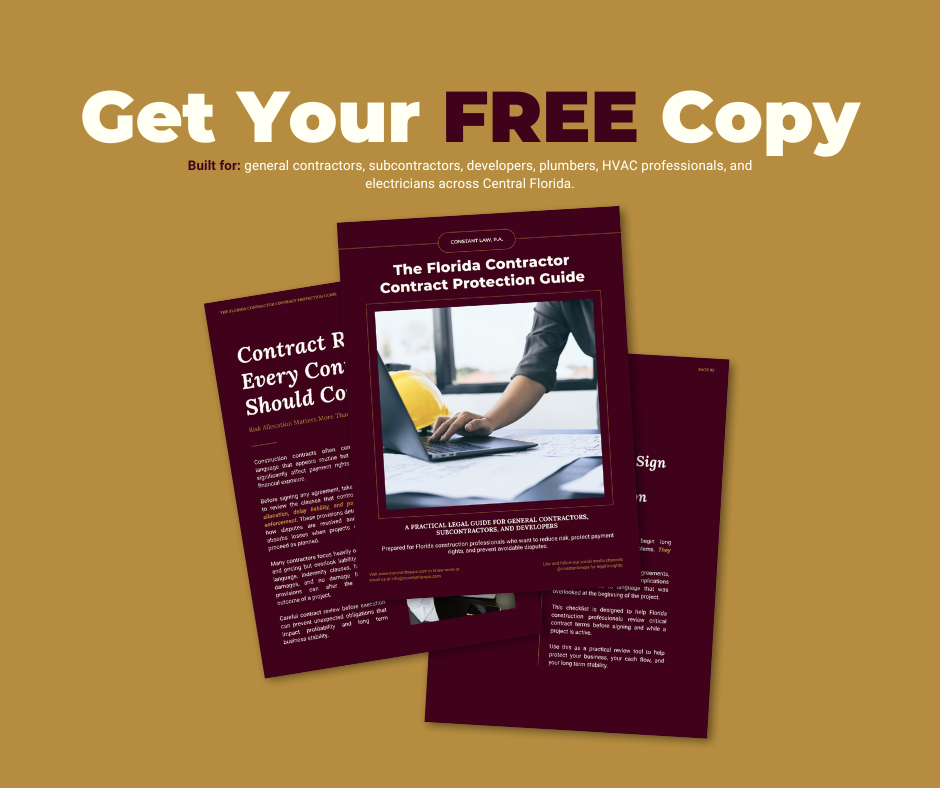
If you’re a contractor, subcontractor, or developer in Florida, you already know how quickly payment issues, unclear contract terms, and project disputes can impact your business. The Florida Contractor Contract Protection Guide breaks down the key legal protections you should have in place before and during every project, from strengthening your contracts to understanding lien rights and avoiding common mistakes that lead to costly disputes. This guide gives you practical, real-world steps you can start using right away to better protect your work, your payments, and your business.
Confidentiality and Data Security Concerns
Construction contracts often contain proprietary pricing structures, trade secrets, and bid strategies. When you upload documents to AI platforms, you may expose sensitive business information. Some AI services retain data for training purposes.
Before using AI to review or generate agreements, you should evaluate whether the platform protects confidentiality. Contractors and developers should not risk disclosing financial or project details that competitors could exploit. Protecting your business includes safeguarding your data. AI convenience should never override security concerns.
Subcontractor Disputes Increase with Poor Drafting
Subcontract disputes often stem from unclear scope language and confusion over payment timing. AI-generated agreements frequently fail to clearly define work boundaries. When scope descriptions overlap or omit essential details, disputes can escalate quickly.
Clear drafting prevents:
- Scope creep
- Change order confusion
- Back charge conflicts
- Payment withholding disputes
Reducing litigation risk is achievable when your agreement clearly outlines responsibilities and documentation procedures. AI cannot anticipate how subcontractors may interpret ambiguous language.
Courts Expect Precision, Not Automation
Judges and arbitrators evaluate contract language carefully. They do not excuse vague drafting because AI generated the document. If your agreement fails to define key obligations, the court will enforce it as written.
Construction litigation often turns on small wording differences. A single undefined term can determine liability. Automated drafting tools cannot anticipate how opposing counsel will attack weak language.
You should treat AI as a drafting assistant, not a substitute for legal review. Construction contracts form the foundation of your financial protection.
When AI Can Help and When It Cannot
AI can assist with administrative tasks such as organizing documents or summarizing meeting notes. It can also help generate preliminary outlines. However, you should never rely on AI as your final contract authority.
Before executing any agreement, consult a professional who understands Florida construction law. A careful legal review strengthens enforceability and aligns the contract with your business objectives.
If you currently utilize automated tools, consider scheduling a contract audit. Reviewing your construction contract process now can help prevent costly disputes in the future.
Technology is continually reshaping construction operations; however, contracts require strategic legal analysis that AI cannot offer. Contractors, subcontractors, developers, and trades must safeguard their businesses with enforceable agreements that comply with Florida law.
If you want to review your current contracts or evaluate the risks of AI-generated documents, contact Constant Law, PA at 863-457-3253 or click here. Our firm helps construction professionals secure strong agreements that protect profit and minimize liability.